
01 / setup
Set up in one afternoon: point a CNAME
-
01
Send us your origin IPs
We provision yourgame.multiplayernode.com and hand you the edge proxy addresses.
-
02
Point your CNAME
Players connect exactly as before. No client update, no SDK, nothing to ship.
-
03
Firewall your origin
Accept only our edge proxy IPs. Your real address disappears from the public internet.
Changed your mind? Delete the CNAME and you are back on your old route in minutes.
Plain TCP, UDP and WebSocket forwarding by default, ws:// and wss:// both, with no certificate handed to us. Need real client IPs at your origin? We support PROXY protocol. Can't support PROXY protocol? We can help you set up mmproxy with no changes to your server binary.
Games are what we know best, but the edge proxies are protocol-agnostic: anything over TCP/UDP works the same way, from voice servers and streaming ingest to trading feeds, IoT fleets, or any API that needs its origin hidden.
02 / the routes
Low-latency routes between Brazil, the US and Europe
We run edge proxies globally, and steer your traffic over several optimized routes between them. Traffic is load-balanced across the proxies, by anycast or DNS, with automatic failover when one drops out. The flagship is our direct Atlantic path: typical Brazil to Europe traffic detours through the US at 220-250ms, while our Sao Paulo and Madrid edge proxies connect over the EllaLink submarine cable at 109.5ms round trip, bare metal to bare metal. Fewer hops also means fewer places to pick up jitter and packet loss. Other regions and custom routes on request.
Ping, jitter and packet loss are what your players actually feel. Ping is the round trip they see in the client, and taking 110ms out of it is the difference between a hit registering and a hit being rolled back. Jitter matters as much as the number itself: a steady 150ms plays better than a ping swinging between 100 and 300, because client-side prediction is only ever as good as its last measurement. Packet loss is the one players call lag, since a dropped packet waits on a retransmit while the world stalls around them. A short, low-latency path on a dedicated cable gives you less of all three.
03 / origin hiding
Your origin address stays off the public internet
Your players connect to our edge proxy IPs, so your origin address never appears in DNS or in traffic. Your firewall accepts only our edge proxies, so the only traffic that reaches your game server is what we forward.
04 / the stack
Bare metal, virtual machines and an anycast load balancer
Our infrastructure runs on both bare metal and virtual machines, picked per region for the route it has to serve. In front of it all sits a load balancer: players are spread across the proxies by anycast or DNS, a node that fails is withdrawn automatically, and the reverse proxy on each node forwards to your origin over the low-latency route, so players see lower ping and fewer lag spikes. Your origin stays where it is: a dedicated server, a cloud VM or any game server hosting provider. High availability comes from the pool, not from any single machine.
- Load balancer
- Reverse proxy
- Bare metal
- Virtual machines
- Anycast
- Edge computing
- Low latency
- High availability
05 / pricing
Pricing
Standard
Global coverage
- Per accelerated port $30/month
- Optimized path cost, any region $0.01/GB
- Standard DDoS protection included
More capacity and other regions on request. Route latency: Sao Paulo to New York 109ms, New York to Europe 70ms, Sao Paulo to Europe 175ms.
Premium
Direct trans-Atlantic route
- Per accelerated port $100/month
- Optimized path cost $0.05/GB
- Brazil to Europe, direct Atlantic path 109.5ms
- Typical route for comparison 220-250ms
- Standard DDoS protection included
For games with players on both continents where latency is the product.
An accelerated port is one TCP or UDP port on your server, covered in every region we run. Extra ports, same rate.
2 TB a month: $50 on Standard, $200 on Premium.
Founding customer pricing, locked for as long as you stay. Rates rise as capacity fills.
7-day free trial. No commitment. Cancel by deleting your CNAME.
How we compare to Cloudflare Spectrum, AWS Global Accelerator, TCPShield and Gcore Edge Proxy
| Multiplayer Node | Cloudflare Spectrum | AWS Global Accelerator | TCPShield | Gcore Edge Proxy | |
|---|---|---|---|---|---|
| Any TCP or UDP game | Yes | Enterprise plan only | Yes | Minecraft only | Yes, from preset profiles |
| WebSocket and wss | Yes | Yes | Yes | No | Not documented |
| Keep your current hosting | Yes | Yes | No, servers run behind AWS | Yes | Yes |
| Setup | Point a CNAME | Move your DNS zone to Cloudflare | AWS account and endpoint config | Point a CNAME | Portal, then repoint clients to their IP |
| Measured Brazil to Europe RTT | 109.5ms, direct Atlantic route | Not published | Not published | No South America presence | Not published |
| DDoS protection | Standard, included | Included | Basic included, advanced is $3,000/mo extra | Included | Included |
| Pricing | $30/mo per port plus $0.01/GB | Enterprise contract, not published | ~$18/mo plus per-GB fees on top of AWS egress | Free to $250/mo | Ports count against plan limit, not published |
| Commitment | None | Annual | None | None | Not published |
Competitor details from public pricing pages and docs as of September 2026.
06 / who we are
Built by the team behind Kakele Online
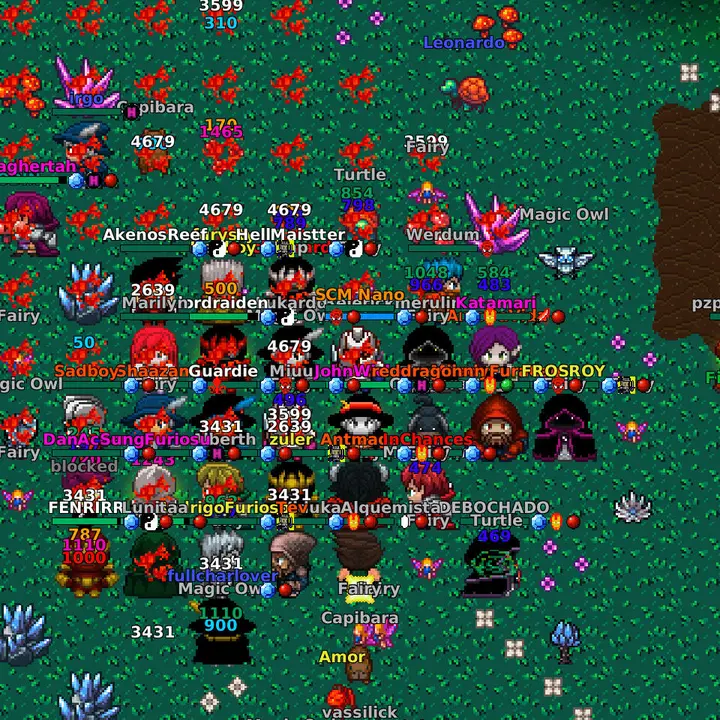
Kakele Online is our cross-platform MMORPG, live for six years, with most of its players in LatAm and Europe. It runs on the same edge proxy network we sell. We are operators, not resellers.
Our team includes two lead developers who previously worked at Google on large-scale distributed systems. For six years we have run the C++ networking behind Kakele, with hundreds of players on screen and 24/7 engineer-led support.
We run the network. You ship the game.
Our network runs on





07 / faq
Questions we get asked
What is an edge proxy?
A reverse proxy that sits between your players and your origin. Players connect to our proxy's address; we forward to your server over the shortest route, and your real address never appears in DNS or in traffic.
What is an accelerated port?
One TCP or UDP port on your server, covered in every region we run. Extra ports are the same rate.
Do I need to change my game client or ship an SDK?
No. Point a CNAME at us and players connect exactly as before. Delete the CNAME and you are back on your old route in minutes.
Can my origin see real client IPs?
Yes, with PROXY protocol. If your server cannot speak it, we help you set up mmproxy with no changes to your binary. There are other options if neither fits: a WireGuard tunnel between us and your origin, and for WebSocket backends a forwarded header carrying the client address.
Is there a trial, and how do I cancel?
A 7-day free trial, no annual commitment. Cancel by deleting your CNAME.
How much ping will my players actually save?
On the Brazil to Europe route, around 110ms: the typical path detours through the US at 220-250ms, ours is 109.5ms measured over the EllaLink cable. The gain on any route is the difference between the public path and ours, so it varies by where your players are. Lower jitter and fewer lag spikes come with it, because a shorter path has fewer hops to pick up packet loss.
Is Multiplayer Node a load balancer?
At the edge, yes. Players are spread across our edge proxies by anycast or DNS, and a proxy that fails is withdrawn automatically. Each proxy is a reverse proxy to your origin; balancing across several origin servers is available on request.
Do you run on bare metal or virtual machines?
Both, chosen per region for the route it has to serve. Your own game server stays wherever it is: a dedicated server, a cloud VM or a hosting provider.
Is DDoS protection included?
Standard DDoS protection is included on every plan. Your origin stays hidden behind our edge proxies, and your firewall accepts only their addresses.